
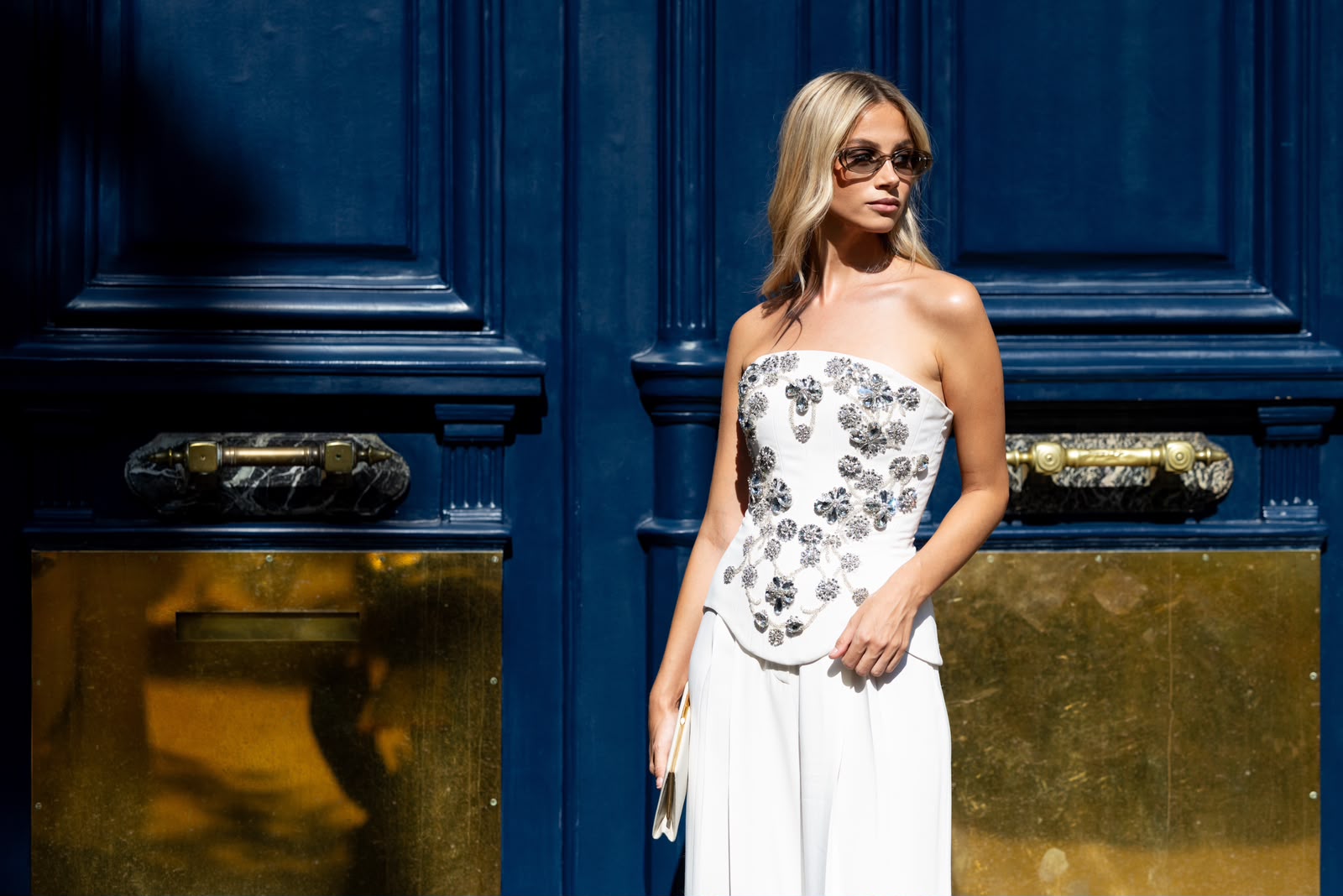
The Lithuanian creative director reflects on a new idea of exclusivity, one that moves beyond ostentation and places greater value on time, privacy, serenity, understated beauty and relationships in which people feel genuinely free.
For many years, luxury was defined by what could be displayed: a recognisable dress, an important piece of jewellery, an exclusive car or a stay at one of the world’s most prestigious hotels.
Today, however, the meaning of luxury appears to be shifting. It is no longer simply about ownership, but about freedom. Not accumulation, but selection. Not visibility at any cost, but the ability to decide what should remain private.
This is the perspective of Simona Jakstaite, a Lithuanian creative director whose professional and personal life moves between Dubai, Milan and Paris, across the worlds of fashion, communication, travel and international events.
Jakstaite is deeply familiar with the traditional language of exclusivity. Haute couture, iconic hotels, design objects and sought-after destinations are all part of her experience. Yet when she speaks about what she considers truly valuable, her attention moves away from possessions and towards quality of life.
‘True luxury is freedom. The freedom to decide how to use your time, where to live, who to share your life with and which people or situations to leave outside it.’
It is a definition that does not reject beauty or the value of exceptional objects, but places them within a more personal and intimate perspective. For Jakstaite, fashion and design remain important, provided they do not become instruments through which people constantly seek the approval of others.
Time as the New Symbol of Wealth
In her view, the rarest luxury is the ability to slow down.
In a society dominated by speed, productivity and constant exposure, being able to choose the rhythm of one’s own day has become a privilege. Having time for an unhurried breakfast, waking without anxiety or spending a few hours away from a telephone can feel more valuable than an expensive purchase.
‘Today, I consider the absence of pressure, privacy, health and peace of mind far more precious than any material possession.’
Her understanding of luxury has changed over the years. Like many people, she once associated it more easily with instantly recognisable symbols: a handbag, a piece of jewellery, a hotel or a car.
With time, however, came the realisation that an object may make life more beautiful without necessarily making it happier.
The real privilege, according to Jakstaite, is being able to live without feeling constantly pursued by commitments, expectations and the need to perform.
Dubai Beyond Opulence
Her perspective has also been shaped by life in Dubai, a city often seen as one of the most spectacular expressions of contemporary luxury.
Monumental architecture, highly efficient services, exceptional hospitality and seemingly limitless possibilities have helped create an image closely linked to abundance. For those who genuinely live in the city, however, its value extends far beyond opulence.
‘For me, the luxury of Dubai is also its safety, efficiency and the sense that you can build your life freely.’
The ability to travel easily, meet people from different cultures and still return to a place that feels like home represents a tangible form of wellbeing.
Luxury, in this sense, is not simply what a city displays, but what it allows its residents to experience.
Fashion as Expression, Not Proof
Jakstaite also reinterprets the relationship between fashion and luxury through the idea of identity.
She does not consider elegance to be an automatic consequence of price or brand recognition. Wearing visible logos does not necessarily demonstrate personal style. Luxury may instead be found in the precise construction of a blazer, the fit of a pair of jeans or the choice of a single accessory that expresses the personality of the person wearing it.
‘A garment becomes truly valuable when it represents you and continues to appeal to you over time, not simply when it is recognised by others.’
Her view reflects the wider conversation surrounding so-called quiet luxury, the discreet form of refinement that has influenced fashion and interior design in recent years. Yet for Jakstaite, the concept cannot be reduced to neutral colours or the absence of logos.
Discreet luxury is first and foremost an attitude: buying less, choosing better and recognising quality without feeling the need to explain its financial value.
‘True elegance does not constantly demand attention. You sense it in the details, in the way someone speaks, in the care they show to others and in the confidence with which they enter a room.’
The Home as a Space for Authenticity
Among the most personal expressions of luxury is the home, not as a showcase, but as a place in which public roles can be left behind.
Jakstaite prefers bright interiors, plants, art and design objects collected gradually. She is not interested in filling a room for the sake of appearance. Instead, she believes every element should have a reason for being there and should carry a story.
Her abstract paintings, created during a particularly happy period in her life, are especially meaningful.
‘Their value is not merely decorative. They contain a memory, an emotion and a part of me. That is what makes something truly precious.’
Value, therefore, is not determined only by rarity or price, but by an object’s ability to preserve a personal experience.
The Privilege of Privacy
Her reflections become even more significant in relation to social media.
Image is an important part of Jakstaite’s work, as is the creation of content linked to fashion, travel and international events. Yet visibility has also taught her the importance of preserving part of her life beyond public view.
‘Not everything needs to be shown. Some moments become more precious precisely because they remain private.’
At a time when experiences, relationships and travel are often shaped by the expectation that they will be shared online, choosing what not to publish has become a form of control over one’s identity.
Privacy, according to Jakstaite, is now one of the rarest luxuries. Visibility may create opportunities, but the ability to establish boundaries is equally essential.
Love and Authentic Relationships
Love also forms part of her definition of luxury, not because of its more spectacular or public side, but because of the possibility of being understood without having to perform a role.
‘Luxury in a relationship is feeling understood even without speaking, being able to share silence and knowing that beside that person you can be strong, vulnerable, elegant or completely natural.’
Feeling protected without losing independence is, for her, one of the deepest forms of wellbeing. It is a privilege that cannot be bought or created through appearances.
The same authenticity can be found in small, everyday moments: an evening with a few close friends, a glass of champagne and a view that provides the backdrop to a sincere conversation.
These experiences may appear simple, but they become increasingly rare when life grows fast, public and fragmented.
The Future of Luxury
Jakstaite believes that luxury will become increasingly personal and less ostentatious in the years ahead.
People will search for quality, craftsmanship, wellbeing, privacy and services capable of returning the most valuable resource of all: time.
Luxury brands, too, will need to adapt, moving beyond the production of expensive objects and towards the creation of authentic, meaningful experiences.
The ultimate privilege will not be owning more, but having the freedom to choose better: what to buy, where to live, who to spend time with and how much of oneself to reveal to the world.
Jakstaite summarises this vision in a statement that goes beyond any passing trend:
‘True luxury is not what you show, but what you no longer feel the need to prove.’